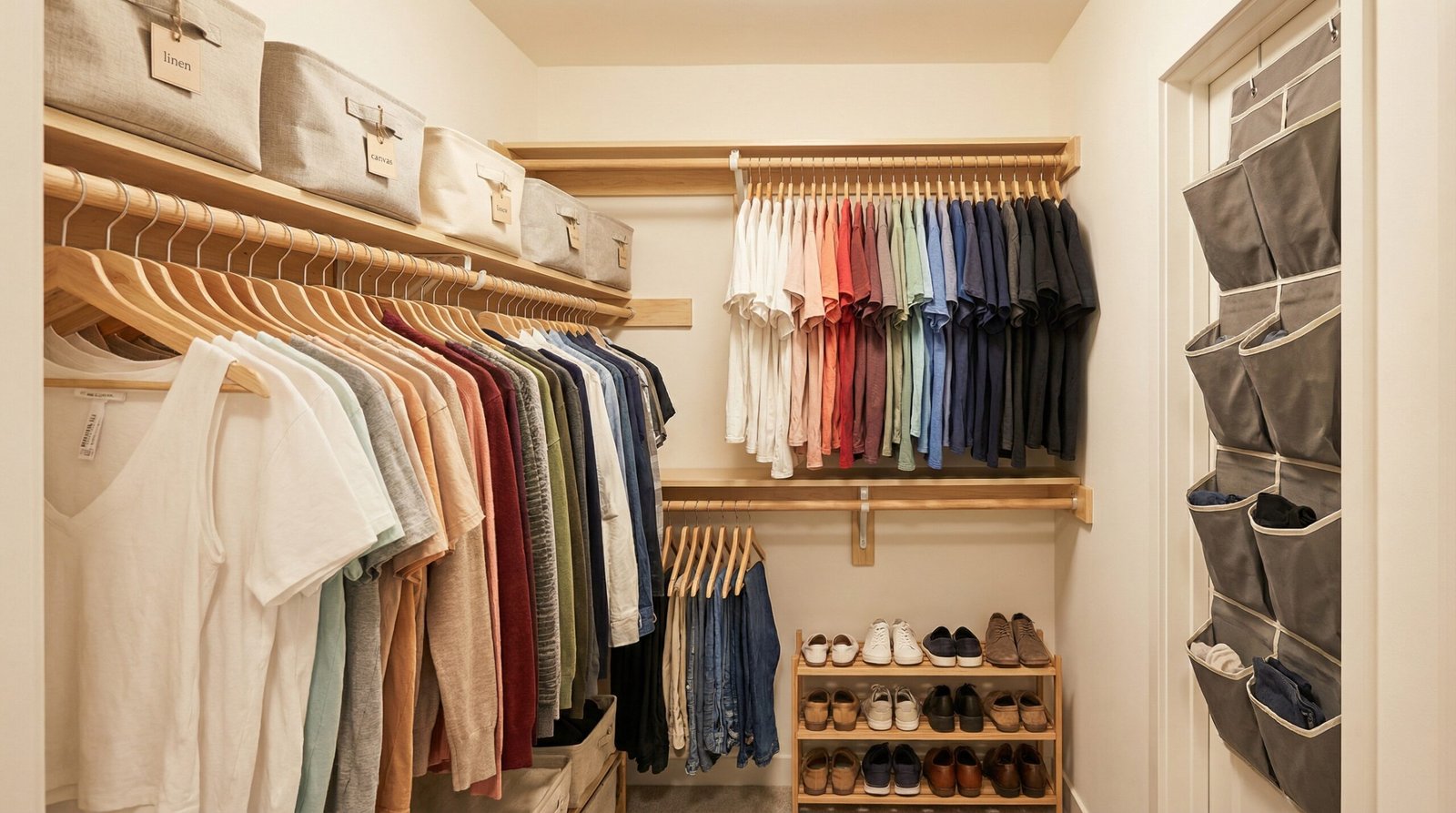
How to Organize a Small Closet (Step by Step)
A small closet can either feel like a functional storage system or a pile of things you’d rather not deal with. The difference almost always comes down to one thing: having a clear process to set it up properly.
Most people approach closet organization by buying storage products first. That’s usually the wrong order. Without knowing exactly what you own and how your closet is currently used, even the best organizers end up making things worse.
This guide walks you through the process from start to finish, in the right order. Follow these steps once, and your small closet will stay organized far longer than any quick tidy-up ever could.
Before You Start
Set aside two to three hours. You’ll need a clear floor space nearby to sort through everything. Have three bags or boxes ready, one for donations, one for items to relocate to another room, and one for things to throw away.
Don’t skip this preparation. Having a sorting system in place before you open the closet makes the whole process significantly faster.
Take Everything Out
Remove every single item from the closet. All of it, clothes, boxes, loose items on the floor, things pushed to the back. The closet needs to be completely empty before you do anything else.
This step feels counterintuitive, especially when the closet is already a mess. However, it’s essential. You can’t see what you actually have until everything is out in the open.
Once the closet is empty, take a moment to clean the shelves and floor. Wipe down surfaces and vacuum any dust. Starting with a clean space makes the whole process feel more manageable.
Sort Everything Into Categories
Go through every item you removed and sort it into groups. Clothes together. Shoes together. Accessories, bags, linens, and miscellaneous items each in their own pile.
As you sort, make decisions: if you haven’t worn something in over a year, it goes in the donation bag; or if it belongs in another room, it goes in the relocate box. Especially, if it’s broken or worn out, throw it away.
Be honest during this step. The goal of a well-organized small closet is to store only what you actually use. Everything else is just taking up space you don’t have.
Useful rule: If you wouldn’t buy it again today, it probably doesn’t need to stay in the closet.
Assess the Space You’re Working With
Before putting anything back, look at the closet itself. How much hanging space do you have? How many shelves? Is there floor space that could hold drawers or bins? Is the back of the door being used?
Most small closets are underutilized vertically. There’s often unused space above the main hanging rod, and the door is almost always left empty. Identifying these opportunities now will shape how you put everything back.
If possible, measure the closet dimensions, width, depth, and height. This makes it much easier to choose organizers that actually fit.
Add a Second Hanging Rod
If your closet has a single hanging rod with empty space below, adding a second rod immediately doubles your hanging capacity. This works especially well for shorter items like shirts, jackets, and folded trousers.
Hang the second rod lower, beneath the first. The space above the original rod can then hold folded items, bins, or boxes. In a small closet, this single change often creates more storage than anything else on this list.
Worth looking into: Closet doubler hanging rods, look for adjustable-width models that hook onto the existing rod with no tools or drilling required.
Use the Door for Storage
The back of the closet door is one of the most overlooked storage surfaces in any home. An over-the-door organizer with pockets or hooks can hold shoes, accessories, scarves, belts, or small folded items; all without taking up any shelf or floor space.
This is particularly useful in small closets where shelf space is already limited. Furthermore, since it hangs on the door, everything stays visible and easy to grab without digging through shelves.
Worth looking into: Over-the-door shoe organizers with clear pockets, they work just as well for accessories, small bags, and folded items as they do for shoes.
Add Shelf Dividers and Bins for Folded Items
Folded clothes on open shelves tend to topple over and create chaos quickly. Shelf dividers keep stacks upright and separated by category. As a result, the shelves stay tidy with very little effort.
For items you don’t need to access daily, off-season clothing, extra linens, or rarely used accessories, use labeled bins or baskets on the upper shelves. Everything stays contained, and the closet maintains a clean, organized appearance even when it’s full.
Worth looking into: Shelf dividers for closets in acrylic or metal, and fabric storage bins with handles for upper shelves, look for bins with a label window on the front.
Organize the Floor Space
Closet floors often become a dumping ground for shoes, bags, and random items. Instead, treat the floor as intentional storage space with a defined purpose.
A shoe rack keeps footwear organized and off the floor. A small drawer unit or a set of stackable bins can hold accessories, bags, or items that don’t hang. If there’s space, a slim rolling cart works well here too, and you can pull it out when you need it.
Worth looking into: Stackable shoe racks with an adjustable or expandable design, models that tilt shoes at an angle tend to use floor space more efficiently than flat racks.
Put Everything Back with Intention
Now that the closet has proper systems in place, return only the items from your sorted piles. Place things where they make sense for how you actually use them, not just where they fit.
Items you reach for daily go at eye level and within easy reach. Seasonal or occasional items go on upper shelves or in labeled bins. Shoes and bags go on the floor or the door. Accessories go in the organizer pockets.
Take your time with this step. The way you place things now will set the pattern for how the closet stays organized going forward.
Good habit to build: Every time you take something out, return it to its exact spot. That’s the entire system. It sounds simple because it is.
How to Keep It Organized Long Term
A well-organized closet doesn’t stay that way by accident. It stays that way because everything has a defined place. When something new comes in, something old goes out. That one-in-one-out approach prevents the closet from gradually filling back up over time.
Do a quick review every few months. Pull out anything you haven’t touched since the last review. Donate it or move it on. It takes fifteen minutes and keeps the system working indefinitely.
According to the National Association of Home Builders, storage and closet space consistently rank among the top priorities for homeowners, which means a well-organized closet adds real value beyond just tidiness.
Final Thoughts
Organizing a small closet isn’t complicated. It just requires doing things in the right order, emptying first, sorting second, then adding systems that match what you actually own.
Start with Step 1 today. Even if you only get through the first two or three steps, you’ll already be in a much better position than before. The rest follows naturally once the process is in motion.
A small closet, done right, can hold everything you need. The key is using every inch of it with intention.